

What does “test-optional” really mean in college admissions? Learn when to submit SAT/ACT scores and how to strategically maximize your admissions advantage.
Over the last several years, test scores have returned to center stage at many of America’s top colleges. Eleven of the top fifteen colleges and universities in the country (per the US News & World Report rankings) have returned to a policy of test-required admissions. While test-optional remains the most widespread policy in college admissions, it is a mistake to assume that test “optional” means test “irrelevant.” Testing can have a very meaningful impact on admissions at test-optional schools, and students have responded accordingly. In the most recent admissions cycle, according to data from the Common App, the number of students submitting test scores (627,979) increased by 11%, while those without test scores (530,826) declined by 2%. More students are choosing to submit test scores because, even at test-optional institutions, strong test scores can significantly strengthen applications.
When it comes to test score submission policies, there are four pathways:
While there are four discrete pathways, test-optional admissions is by far the most popular among US colleges.
Test-optional means different things at different institutions. Every admissions office has its own preferences, admissions algorithms, philosophy, and stance towards testing. Admissions offices conduct analyses of the various admission factors to determine their relative weights in predicting academic success in college. While some colleges find test scores to be a relatively weak predictor of performance for their student body, other schools, particularly highly selective schools, find testing to be highly predictive of academic performance. The outcomes of these analyses impact how much weight each admissions office places on standardized test scores.
The majority of colleges that have returned to testing requirements cite the results of their internal analyses, revealing the powerful predictive value of test scores. Test-submitters frequently have better educational outcomes, higher grades, retention rates, and graduation rates.
We learned from the University of Texas at Austin that test scores are nearly essential to ensure the right students are admitted to the right academic programs. Students without test scores were achieving freshman grades nearly a full point (0.86) below their matched peers who submitted test scores, and they were 55% more likely to be on academic probation (below a 2.0 GPA). Students performing at lower levels require more resources and academic support and pose a greater risk of dropping out. This discrepancy in academic performance drove the Texas flagship to reinstate test requirements.
The Ivy Plus study conducted by Raj Chetty and other researchers from the Opportunity Insights group found that for the Ivies plus Chicago, Stanford, Duke, and MIT, standardized test scores were much better than high school grades at predicting collegiate academic performance. The results of their analysis were striking.
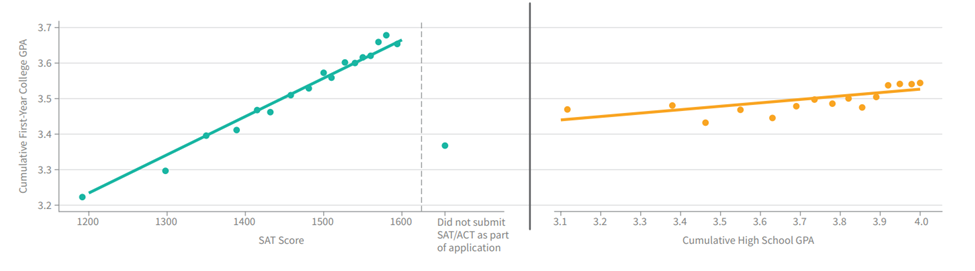
In their internal study of variables predicting performance at Dartmouth, researchers Bruce Sacerdote and colleagues found that high school grades predict a mere 9% of the variance in college grades, while the SAT, by itself, explains 22% of the variance. Combining the two variables explains 25% of the variance in grades at Dartmouth. The SAT is the single best predictor of academic achievement for all demographic groups, which helped fuel Dartmouth’s decision to reinstate testing requirements. In light of this research, nine of the twelve members of the Ivy Plus group have now reinstated testing requirements: MIT, Dartmouth, Yale, Harvard, Brown, Penn, Princeton, Cornell, and Stanford.
Math scores on the SAT and ACT help colleges with a STEM focus gauge the relative quantitative strength of applicants. MIT was one of the first universities to reinstate test requirements in 2022. Stuart Schmill, MIT’s Dean of Admissions, explained the rationale behind this policy shift: “Our research has shown that, in most cases, we cannot reliably predict students will do well at MIT unless we consider standardized test results alongside grades, coursework, and other factors.” Other STEM giants, CalTech, Carnegie Mellon, GA Tech, Johns Hopkins, and others have since returned to test requirements. Johns Hopkins noted that its admissions office was “seeking to gain confidence in the math preparation of applicants who indicate an interest in math-intensive courses of study like engineering and natural sciences.” Similarly, Cooper Union reinstated test requirements for its engineering school applicants.
Test-optional admissions policies provide many benefits to colleges:
Given these benefits, some schools will be unwilling to revert to test-required admissions, even if their own institutional data suggests the value of that approach.
Some admissions offices are more transparent regarding the relative weight of testing in the admissions process.
1) Recommendations, encouragements, and other clues
Colleges that describe test scores with phrases such as “encouraged,” “recommended,” and “help” in their description of their policies indicate that testing, while optional, remains impactful in the admissions process.
2) Percentage of enrolled students who submitted test scores
One way to gauge the relative impact of test scores on admissions is to examine the percentage of students who were accepted and enrolled with test scores compared to the percentage of nonsubmitters, data readily available on the Common Data Set for all colleges.
Take the University of New Hampshire, for example. UNH has a high acceptance rate of 88% and among enrolled students, only a small fraction of students submitted test scores: 22.7% submitted SAT scores and 1.8% submitted ACT scores. Considering the high acceptance rate and low rate of test-score submission, it can be inferred that test scores play a relatively minor role in the admissions process at UNH. Contrast this to another test-optional school, the University of Chicago. Chicago has a 4.6% acceptance rate, and roughly three-fourths of the enrolled students submitted test scores: 49% SAT and 27% ACT. While we don’t know the exact weighting test scores receive at Chicago, it can be reasonably inferred that they play a larger role in the conversation there than they do at New Hampshire.
We saw this play out at Yale, a school that was test-optional for several years. Once applications arrived inside the admissions office, the treatment of students with and without test scores was not remotely similar. In fact, students without test scores had a 2% chance of gaining admission, while students with test scores had a 6% chance of admission—triple the odds. The Dean of Undergraduate Admissions, Jeremiah Quinlan, understood that “students who were not submitting their test score were inadvertently hurting their chances of admission to Yale.” He admitted, “I became more and more convinced that we weren’t being honest about the reality of our admissions process to students and parents.” Calling the policy test-optional felt disingenuous, and the admissions office reversed course and reinstated testing requirements. Yale came clean and corrected the misperception that students had an equal shot of getting in with or without tests, but many other admissions offices have yet to make that correction.
The vast majority of US colleges, over 2,000, are test-optional. The Common App reports that only 5% of member colleges require test scores. But test score submission is on the rise at selective and highly desirable schools. In 2025, seven selective schools announced a return to testing requirements: Miami (58,000+ applicants), Penn (65,000), OSU (88,000), Carnegie Mellon (34,000), Auburn (55,000), Princeton (42,000), and Alabama (58,000). That equates to some 400,000 apps that will include test scores. In 2024, Yale, Brown, UT, Harvard, Caltech, Cornell, Stanford, and Johns Hopkins reinstated testing requirements, resulting in an additional 400,000 apps. As the Common App data shows us, test-score submitters are rising, while non-submitters are falling.
.png)
The rise in the number of colleges that require test scores will lead to higher rates of voluntary test-submission at test-optional schools. Those students who are cross-applying to test-required schools like Texas, Miami, GA Tech, and Carnegie Mellon will be much more likely to include their competitive scores when they apply to UNC, Tulane, and Virginia Tech. A strong score can be helpful at both test-required and test-optional colleges, and the students who put in the work to attain competitive scores will want to claim that advantage.
Sometimes, yes, particularly at highly selective schools. Yale was transparent when it explicitly said that “inviting students to apply without any test scores can, inadvertently, disadvantage students from low-income, first-generation, and rural backgrounds” and that some students “unwittingly hurt their chances” by withholding scores that would have helped.
Highly selective schools receive so many applications with robust grades and rigorous course-taking. With grade inflation running rampant, anything that can differentiate an application can be beneficial. Strong test scores can be a differentiating factor.
Applying to a test-optional school without submitting test scores can be the best course of action if:
Step 1: Identify the school’s testing policy
Step 2: Compare your score to the two relevant contexts
Step 3: Consider your intended major
Step 4: Consider whether the test score enhances or strengthens your application
Step 5: Consider whether testing can affect scholarships
Step 6: Submit your score if it is clearly competitive
Step 7: Remember to treat every application differently
While the admissions world remains predominantly test-optional, our understanding of what test-optional means has sharpened. More admissions offices have shared their insights on testing and how test scores impact their decision-making and predict student outcomes. The vast majority of colleges will remain test-optional, but test scores will be a meaningful admissions factor at many of these colleges, especially those that are more selective. In response, students will submit test scores to those optional schools at higher rates. Thus, the new world will be test-optional, but far from test-irrelevant. Treat testing as an advantage that can bolster an application, and omit testing only when it is strategic to do so. Meanwhile, given the trends over the last several years, we anticipate an increase in the number of test-required schools, the selective privates, and the flagship publics. Having a strong test score will be an asset in this new admissions landscape.